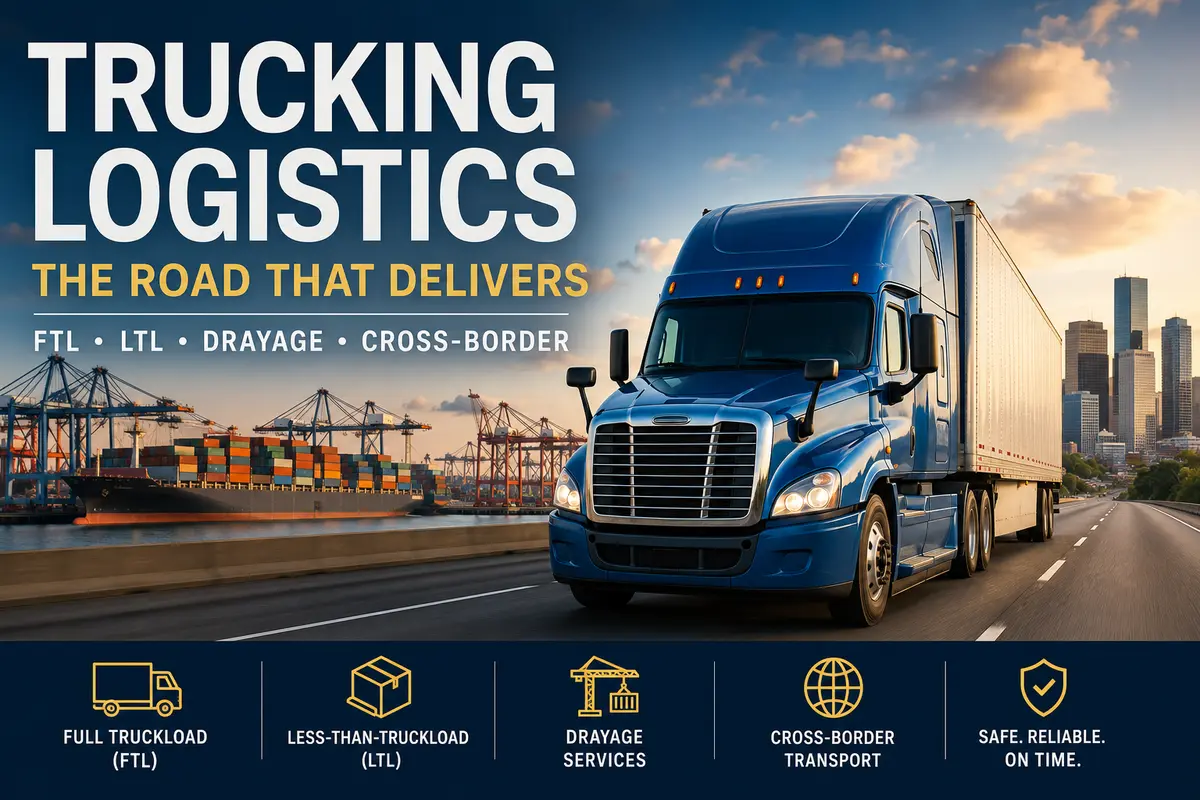
Trucking logistics is the coordination of ground freight — matching cargo to the right carrier, equipment, and route so it moves from a port, rail yard, or warehouse to its final destination. It’s the road layer of the supply chain. And it’s where most shipments actually finish.
Most shipments don’t end at a port. They end at a loading dock, a distribution center, a back warehouse somewhere off the highway. That last leg runs on trucks.
Ground transportation is easy to overlook when you’re deep in ocean freight negotiations or tracking an air shipment. But it’s where cargo actually finishes its journey — and where a lot of avoidable delays happen. That’s why it belongs in any serious conversation about logistics services.
Key Takeaways
- Trucks finish the job. Ocean and air move cargo across borders and oceans — trucking logistics is what gets it to the dock.
- FTL or LTL — know the difference. One trailer, one shipper, direct delivery. Or shared space, lower cost, more complexity. Wrong choice costs money either way.
- Drayage needs to be arranged before CBP releases cargo. Not after. That’s where port fees pile up fast.
- US-Mexico freight still mostly transfers at the border. General “we handle Mexico” claims aren’t the same as actual corridor experience.
- Separate vendors create gaps. Trucking, customs, and freight forwarding under one provider means no one’s waiting on a call from someone else.
- Check the FMCSA SAFER database before booking any carrier. Public record. Two minutes. No excuses.
What Trucking Logistics Actually Means
Trucking isn’t one thing. It’s a set of service types, each built for a different kind of freight.
- FTL (full truckload) — one shipper’s cargo, one trailer, straight through. No shared space, fewer touchpoints.
- LTL (less-than-truckload) — shared trailer space with other shippers. Lower cost for smaller loads, more handling and longer transit.
- Flatbed — heavy, oversized, or oddly shaped equipment that won’t fit a dry van.
- Reefer — refrigerated trailers for anything temperature-sensitive.
- Drayage — the short haul between a port or rail yard and a nearby facility.
A manufacturer moving 40,000 pounds across three states books FTL. Ten pallets from Houston to Dallas? Probably LTL. Industrial equipment off a vessel needs flatbed the minute customs releases it. Same industry, completely different requirements.
Where Trucking Fits in the Supply Chain
International freight doesn’t end when the ship docks.
Customs clearance comes first — classification, entry filing, duty payment, CBP release. Only after that does cargo move toward its destination. That handoff from port to final delivery is where things go sideways when ground transportation isn’t lined up in advance.
Rocio Saldivar, Licensed Customs Broker at Posey International, has seen it repeatedly: the worst bottlenecks aren’t at sea or in the air. They’re at the gap between customs clearance and domestic pickup. Separate vendors, poor communication, cargo sitting on a port while detention fees run. It’s avoidable when one provider handles both sides.
Full Truckload vs. Less-Than-Truckload
Choosing between FTL and LTL comes down to the shipment details.
FTL books the whole trailer — 48 or 53 feet — direct from pickup to delivery. No other shippers, no extra stops, less handling. Shipments over about 15,000 pounds or 12 pallets almost always pencil out cheaper per unit this way.
LTL shares the space. Pay for what the freight occupies, nothing more. Good for smaller loads. The catches: longer transit times, more touchpoints, and pricing that hinges on freight class, weight, and lane. Get any of those wrong and it gets expensive fast.
Drayage — The Most Overlooked Piece
Short-haul trucking. Usually under 50 miles. Moves containers from ports and rail terminals to wherever they’re going next.
It’s a small piece of the total journey geographically. Operationally it’s where port congestion bites hardest. Chassis shortages, backed-up appointment windows, containers sitting while the detention clock runs — that’s a drayage problem. At Houston, getting this coordinated before CBP releases cargo is the difference between same-day movement and three days of fees.
Plan it in advance. Not after.
Cross-Border Trucking: The US-Mexico Factor
USMCA adjusted the compliance picture for US-Mexico freight, but cross-border trucking is still operationally complex. The majority of commercial volume still transfers at the border — US carrier to the crossing, customs processing, Mexican carrier forward. Or the reverse.
Long-haul access for Mexican carriers has expanded, but the handoff model dominates real-world volume.
Brownsville is a key commercial gateway into northeastern Mexico. Knowing that corridor — the timing, the inspection patterns, the processing quirks — comes from working it, not reading about it. Posey International’s trucking company services include cross-border coordination with direct operational experience at that crossing.
How Trucking Integrates with Freight Forwarding
Most international shipments aren’t one leg. They’re several — ocean or air, customs clearance, drayage, final delivery.
When those legs are coordinated by one provider, the handoffs actually work. Vessel arrives, entry’s already filed. CBP releases, truck’s already scheduled. Container hits the warehouse, inventory’s updated. Nobody waiting on a call from another vendor.
What to Look for in a Trucking Partner
Rate matters. It’s not the only thing that matters.
FMCSA authority and safety rating — check it first, every time. The FMCSA SAFER database is public. Two minutes. Ratings, inspection history, authority status, all of it. Don’t skip this step.
Equipment. Dry van capacity is generally available. Flatbed, reefer, and specialized equipment get tight during peak seasons and in certain lanes. Established carrier relationships mean access to capacity that isn’t showing up on the spot market.
Lane knowledge. The Houston-to-Monterrey corridor has its own patterns — typical wait times, common inspection triggers, border-specific quirks. A carrier running that lane regularly knows things a newcomer doesn’t. That knowledge shows up as fewer surprises.
Customs coordination. Does the trucking provider understand that pickup gets scheduled around the CBP release — not before it? That one detail prevents a whole category of delays.
Trucking Logistics Glossary
- FTL — Full truckload. One shipper’s freight fills the trailer.
- LTL — Less-than-truckload. Trailer space shared across shippers.
- Drayage — Short-haul move between a port or rail yard and a nearby facility.
- Chassis — The wheeled frame a container rides on behind the tractor.
- Detention — Fees charged when equipment sits longer than the free time allowed.
- Freight class — NMFTA classification (50–500) that drives LTL pricing.
Frequently Asked Questions
What’s the difference between a trucking company and a freight broker?
A trucking company owns equipment and physically moves freight. A freight broker doesn’t own trucks — they match shippers with carriers and take a margin. Plenty of providers do both. Worth asking which model you’re dealing with before signing anything.
How are trucking rates calculated?
FTL: distance, lane, fuel, and how tight capacity is in that market. LTL: freight class, weight, and origin-to-destination distance. Class is the one that trips people up. Misclassify the freight and the carrier fixes it at delivery — with a bill.
What is freight class and why does it matter for LTL?
It’s a standardized system from the National Motor Freight Traffic Association, Class 50 through Class 500. Denser, easier-to-handle commodities sit at the low end — cheaper to ship. Light, fragile, or awkward freight gets classified higher and costs more. The mistake happens when shippers guess. Carriers don’t guess — they measure and rebill.
What documents are required for cross-border trucking to Mexico?
Commercial invoice, packing list, bill of lading, and a Pedimento — Mexico’s customs entry document. Some commodities need additional permits or certificates on top of that. A licensed customs broker handles both sides of the documentation.
Does cargo insurance cover trucking moves?
Standard carrier liability is limited by federal regulation. Released value often doesn’t come close to actual cargo value. Separate cargo insurance fills that gap. High-value or fragile shipments especially — arrange coverage before the truck leaves.
Trucks are how freight actually gets delivered. Not tracked on a screen — delivered. To a dock, a warehouse, a facility.
Your Freight Needs a Ground Game
For companies moving goods through Houston or across the US-Mexico border, Posey International’s trucking and ground transportation services tie directly into customs clearance and freight forwarding. One provider, no handoff gaps. Contact Posey International to talk through ground transportation options for your supply chain.